SEO for Food Trucks and Mobile Businesses: How to Rank When You Are Always Moving
Google Maps wants a fixed address, but your business is always moving. Learn how food trucks and mobile service providers can dominate local SEO without a storefront.
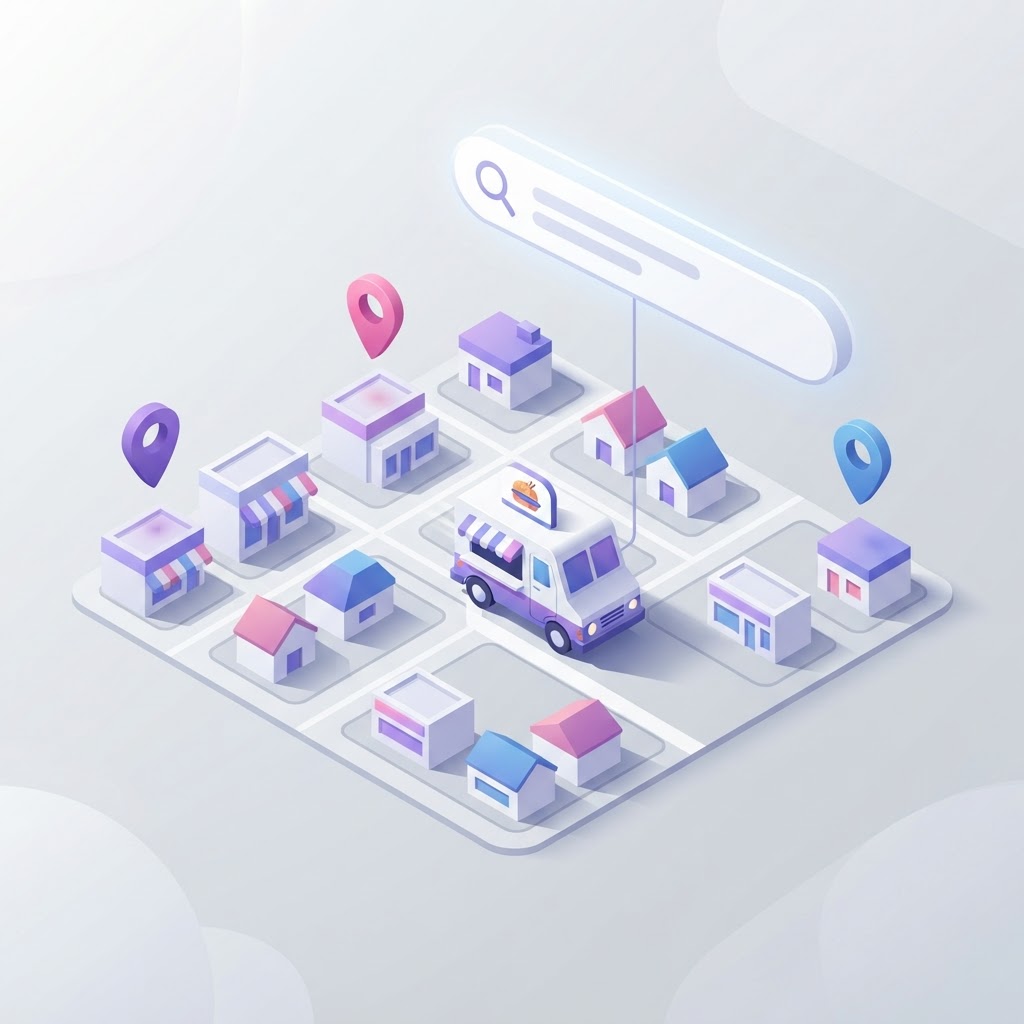
Local SEO is built on a fundamental assumption: businesses have a front door. Google Maps wants to drop a red pin on a specific street address and send customers there. But if you run a food truck, a mobile detailing service, or a pop-up retail shop, your front door moves every day.
This creates a massive problem for mobile businesses. How do you capture local search traffic like "taco truck near me" or "mobile dog groomer in Austin" when your location is constantly changing? If you try to game the system by creating fake listings for every neighborhood you visit, Google will suspend your profile. If you do nothing, you lose customers to competitors who are easier to find.
See how clearly your website communicates your location and services.
InspectRank reviews your local visibility signals and gives you a clear, prioritized report.
Get My Free ReportThe solution is a specific approach to local search designed for Service Area Businesses (SABs). Here is how to build an SEO strategy that travels with you.
The Google Business Profile Strategy for Mobile Businesses
Your Google Business Profile (GBP) is the most important asset for local discovery. For a mobile business, the setup process requires a specific configuration to avoid suspension while maximizing visibility.
1. Claim as a Service Area Business (SAB)
Google explicitly forbids using a P.O. Box, a virtual office, or a temporary parking spot as your primary business address. Instead, you must set up your profile as a Service Area Business. This tells Google that you travel to your customers (or meet them at temporary locations) rather than having them visit a permanent storefront.
When setting up or editing your profile, clear the physical address field. Instead, define your service area by selecting the specific cities, postal codes, or regions you regularly serve. According to Wix SEO Hub, Google will highlight this service area on your profile with a shaded polygon rather than a single pin.
2. Keep Your Operating Hours Accurate
Food trucks often have erratic hours. If a customer drives to a location based on your Google profile and you aren't there, they will leave a one-star review. Use the "Special Hours" feature in GBP to update your schedule weekly, or clearly state in your business description that your hours and locations vary and direct them to your website's schedule page.
Website Architecture: Stop Confusing Google
Many food trucks make the mistake of trying to answer every question on a single, cluttered homepage. To rank well, you need to map every customer query to one canonical page. As noted by The Stacc, you should give each search task one strongest destination.
The Schedule Page
This page owns the query "where are you today?" It should be the only place on your website that lists your current and upcoming locations. Do not duplicate your schedule on your homepage, your menu page, and your about page. If you update your schedule in one place, you never have to worry about conflicting information confusing search engines or customers.
The Menu or Services Page
This page owns the query "what do you serve?" or "what do you do?" Optimize this page for your specific offerings. Instead of just listing items, use descriptive, intent-based keywords. If you serve vegan Mexican food, make sure phrases like "vegan tacos" and "plant-based nachos" are prominent. This helps you capture long-tail search traffic from people looking for exactly what you offer.
The Catering and Private Events Page
Walk-up traffic pays the daily bills, but catering and private events drive major revenue. Create a dedicated page for catering. This page should target high-intent keywords like "food truck catering for weddings" or "corporate event mobile detailing." Because catering isn't tied to your daily parking spot, this page can safely target a much broader geographic area.
Mastering Service Area Pages (SAPs)
If you want to rank in surrounding towns without a physical address, you need Service Area Pages. These are dedicated pages on your website for the specific neighborhoods or cities you frequent.
See how clearly your website communicates your location and services.
InspectRank reviews your local visibility signals and gives you a clear, prioritized report.
Get My Free ReportHowever, you cannot just duplicate the same page and swap out the city name. Google considers this doorway page spam. To make your SAPs rank, they must provide unique, localized value. Search Engine Land recommends incorporating customer-centric language and answering local FAQs.
- Mention local landmarks: "Find us parked near the downtown transit center every Tuesday."
- Highlight local partnerships: "Proudly serving the employees at the Northside Tech Park."
- Include local reviews: Embed reviews specifically from customers in that neighborhood.
If you are unsure how to structure these, our guide on how to rank in surrounding towns without a physical address provides a complete framework.
Mobile Optimization is Non-Negotiable
Nobody searches for a food truck from a desktop computer in a home office. They search from their phones while standing on a sidewalk, sitting in a car, or walking out of a bar. If your website is slow, hard to read on a small screen, or uses a PDF for a menu, you will lose the customer.
Google uses mobile-first indexing, meaning it only cares about the mobile version of your site when determining rankings. Ensure your site loads in under three seconds, features massive "Order Now" or "Find Us Today" buttons, and uses text-based menus rather than pinch-to-zoom images. If you are still checking your site on a laptop, you need to read our breakdown on why desktop rankings do not matter for local businesses.
The Power of Reviews for Mobile Businesses
When you lack a physical address, trust signals become your strongest ranking factor. Google relies heavily on customer reviews to determine if a mobile business is legitimate, active, and popular.
Because your location changes, your reviews are the only permanent proof of your quality. You need a system to consistently generate them. Put a QR code on your truck, your napkins, or your receipts that links directly to your Google review page. Train your staff to ask for reviews after a great interaction. If you need a strategy that won't get you penalized, check out our guide on how to get Google reviews safely.
Fixing NAP Inconsistencies
NAP stands for Name, Address, and Phone number. For traditional businesses, NAP consistency across directories (Yelp, TripAdvisor, YellowPages) is crucial. For mobile businesses, it's a nightmare.
If you previously registered your business using your home address, and that address is still floating around on old Yelp profiles or local chamber of commerce websites, it will confuse Google's algorithm. You must audit your local citations and ensure your address is either hidden (matching your SAB status on Google) or updated to your official business mailing address consistently across the web. Learn how to fix NAP inconsistencies before they ruin your rankings.
Conclusion
Ranking a mobile business requires accepting that you play by different rules. Stop trying to trick Google into thinking you have a permanent storefront. Instead, lean into your mobility. Claim your Service Area Business profile, build a website architecture that clearly separates your schedule from your services, optimize ruthlessly for mobile phones, and let your customer reviews prove your authority.
Sources & references
See what InspectRank finds on your website
Get a clear report covering website SEO, technical health, local visibility and AI search readiness.
Get My Free ReportRelated guides
How to Optimize Your Small Business for 'Things to Do' Local Searches
Struggling to rank for 'things to do' in your city? Learn how local entertainment and hospitality businesses can use Barnacle SEO, Google Business Profile optimization, and hyper-local content to capture tourist and local search traffic.
The SEO Impact of Using a Virtual Receptionist or Answering Service
Discover how missed calls damage your local search rankings and why using a virtual receptionist or answering service can protect your Google Business Profile.
How to Optimize Your Small Business for In-Car Navigation Systems
Cars are becoming search engines on wheels. Learn how to optimize your local business for in-car navigation systems like Google built-in, Apple Maps, and TomTom.

The SEO Dangers of Using Stock Photos on Local Service Pages
Do stock photos hurt your local SEO? Learn why generic images destroy customer trust, kill image search traffic, and drag down your Google rankings.
Local SEO for YMYL Businesses: Ranking Medical Spas, Therapists, and Clinics
Ranking a medical spa, therapy practice, or clinic requires navigating Google's strict YMYL guidelines. Learn how to use E-E-A-T, practitioner profiles, and symptom-based SEO to dominate local healthcare search.