Google Local Services Ads vs. Local SEO: Where Should You Spend Your Budget?
Should you pay Google for immediate leads or invest in long-term organic rankings? Here is the candid truth about Local Services Ads vs. Local SEO for service businesses.
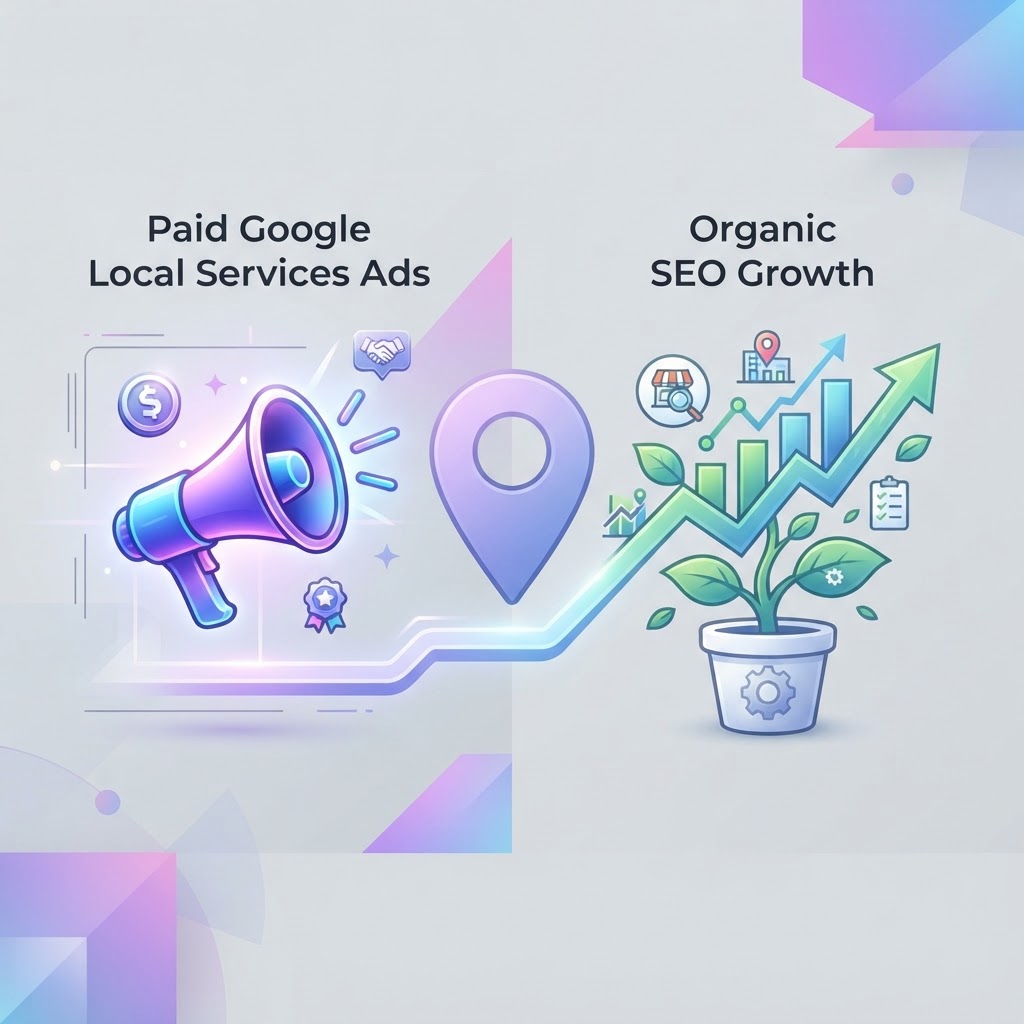
You have a limited marketing budget and you need the phone to ring. When you look at the top of a Google search result for your industry, you see two distinct ways to get there: paying for Google Local Services Ads (LSA) or investing in Local SEO to rank organically. If you ask a paid ads agency, they will tell you LSA is the only way to guarantee leads. If you ask an SEO agency, they will tell you paying for ads is a waste of money because you are just renting space. The candid truth? They are both right, and they are both wrong. Choosing between Local Services Ads and Local SEO is not a philosophical debate about marketing—it is a financial decision about cash flow, customer intent, and business maturity.
The Core Difference: Renting vs. Owning Your Visibility
To understand where to put your money, you have to understand the fundamental difference in how these two channels operate.
See how clearly your website communicates your location and services.
InspectRank reviews your local visibility signals and gives you a clear, prioritized report.
Get My Free ReportGoogle Local Services Ads (LSA) is a pay-per-lead advertising platform. Your business appears at the absolute top of the search results, above traditional pay-per-click (PPC) ads and organic map listings. You earn a green checkmark (the Google Guaranteed or Google Screened badge), and you only pay Google when a customer actually calls or messages you through the ad. It is highly effective, but you are renting your position. The moment your credit card declines or you pause your budget, your phone stops ringing.
Local SEO is the process of optimizing your website and your Google Business Profile to rank naturally in the Local Map Pack and the organic search results below it. You do not pay Google a dime for these clicks or calls. However, you pay with time, effort, and usually an upfront investment in content, technical optimization, and digital PR. Local SEO is an owned asset. Once you build the authority to rank, you generate leads 24/7 without paying a toll for every phone call.
A line graph comparing Cost Per Lead (CPL) over time. The LSA line remains flat and high (e.g., $80/lead indefinitely). The Local SEO line starts extremely high (high upfront cost, zero initial leads) but curves sharply downward over 12 months, eventually stabilizing at a fraction of the LSA cost as organic traffic compounds.
Deep Dive: The Reality of Local Services Ads in 2026
Google designed LSA to solve a specific problem: consumers were getting scammed by unverified contractors, and businesses were tired of paying for useless clicks in traditional Google Ads. According to Google Ads vs. Local Service Ads: What's the Difference?, LSA shifts the risk by charging per lead rather than per click, while requiring businesses to pass background checks and provide proof of insurance.
The Pros of LSA
- Immediate Cash Flow: Once you pass the background check (which can take weeks), you can turn the ads on and get phone calls the same day.
- High Trust: The Google Guaranteed badge tells consumers that Google backs your work up to a certain dollar amount. This artificially injects trust into a brand-new business.
- Predictable ROI: Because you pay per lead, it is very easy to calculate your return on investment. If a roofing lead costs $100 and you close 1 in 4, your cost to acquire a customer is $400.
The Cons of LSA
- It Is Expensive and Getting Worse: You are bidding against every other hungry contractor in your city. Data from Best Lead Generation for Contractors: Real Lead Costs in 2026 shows that while LSA is often cheaper than traditional PPC, costs are rising. A plumbing lead might cost $45, while a roofing lead can easily run $75 to $150.
- Zero Asset Value: You are building Google's business, not yours. If you spend $50,000 on LSA this year, you start at zero again on January 1st of next year.
- Dispute Headaches: While Google claims you only pay for valid leads, fighting Google for a refund on a spam call or a customer outside your service area is notoriously frustrating.
Deep Dive: The Reality of Local SEO
Local SEO is the long game. It involves optimizing your website architecture, earning local backlinks, managing citations, and getting more Google reviews to prove to Google that you are the most relevant and prominent answer in your city.
The Pros of Local SEO
- Massive ROI at Scale: Once you rank in the top 3 of the Map Pack, the volume of calls you receive can be staggering. Because your monthly SEO costs are relatively fixed, your cost-per-lead drops dramatically as traffic increases.
- Captures Research Intent: Not every customer is in an emergency. If someone is planning a $40,000 kitchen remodel, they are not clicking the first LSA ad they see. They are scrolling down, reading reviews, visiting websites, and looking at portfolios. SEO captures these high-ticket, high-research customers.
- Business Valuation: A business that generates its own organic leads is worth significantly more to a potential buyer than a business entirely dependent on paid ads.
The Cons of Local SEO
- It Is Painfully Slow: If you launch a new website today, you will not see meaningful organic traffic tomorrow. It typically takes 4 to 8 months of consistent effort to unseat established competitors.
- Requires Ongoing Maintenance: SEO is not a set-it-and-forget-it strategy. Competitors will try to outrank you, and Google updates its algorithm constantly. You must continually invest in writing local service pages and earning reviews.
The Comparison Matrix
Use this framework to evaluate which channel fits your current business reality. As noted by LSA vs SEO for Home Services: Cost & Budget Guide | BMA, your choice depends heavily on your speed requirements and cost tolerance.
| Decision Factor | Local Services Ads (LSA) | Local SEO |
|---|---|---|
| Speed to First Lead | Immediate (Once approved) | 4 to 8 Months |
| Cost Structure | Pay Per Lead (Variable) | Upfront & Ongoing (Fixed) |
| Customer Intent | Emergency / Transactional | Research / Informational |
| Asset Ownership | Rented (Google owns it) | Owned (You own the equity) |
| Scalability | Capped by local search volume and budget | Unlimited keyword and service area potential |
Search Intent: Emergency vs. Research
The biggest mistake small business owners make is treating all search traffic as identical. It is not. You have to align your budget with the psychology of your customer.
The Emergency Customer: Imagine a homeowner wakes up at 2:00 AM to a burst pipe flooding their basement. They grab their phone and search 'emergency plumber near me'. They do not care about your company history. They do not want to read your blog post about winterizing pipes. They want a trusted professional at their house in 20 minutes. They will click the very first Google Guaranteed LSA badge they see and hit 'Call'. If you are an emergency service provider (plumber, locksmith, towing, HVAC repair), LSA is non-negotiable. You must be there.
See how clearly your website communicates your location and services.
InspectRank reviews your local visibility signals and gives you a clear, prioritized report.
Get My Free ReportThe Research Customer: Now imagine a homeowner looking to install a custom backyard patio. This is a $25,000 investment. They search 'best hardscaping contractors'. They are going to ignore the ads. They will scroll to the Map Pack, open three different websites, look at project galleries, read your 'About Us' page, and check your Google reviews. If you rely solely on LSA for this type of service, you will lose to the competitor who invested in Local SEO and built a comprehensive, trustworthy website.
The 2026 Hybrid Playbook: How to Use Both
The most successful local businesses do not choose between LSA and SEO—they use them in a specific sequence to fund their growth. If you are mapping out your 2026 SEO roadmap for service businesses, here is the exact playbook to follow.
Phase 1: The LSA Cash Flow Engine (Months 1-3)
If you are a new business, or if you desperately need revenue this week, allocate 80% of your marketing budget to Local Services Ads. Go through the painful background check process. Get the Google Guaranteed badge. Turn the ads on and answer the phone on the first ring (Google tracks your responsiveness and will penalize your ad rank if you miss calls). Use LSA to generate immediate cash flow and keep your crews busy.
Phase 2: Funding the SEO Asset (Months 4-12)
Once LSA is generating consistent revenue, do not just pocket all the profit. Take a portion of that revenue and reinvest it into Local SEO. Start building out dedicated service pages for every specific job you do. Optimize your Google Business Profile. Implement a strict system for requesting reviews from every customer you acquire through LSA. You are essentially using Google's paid platform to fund the creation of your organic asset.
Phase 3: The Flip (Year 2 and Beyond)
Around the 8-to-12-month mark, your Local SEO efforts will start bearing fruit. Your phone will start ringing from organic Map Pack rankings. Because you are not paying per lead for these calls, your profit margins on these jobs will be significantly higher. At this point, you can begin dialing back your LSA budget, or you can keep LSA running purely to dominate the entire first page of Google. According to Roofing PPC — Google Ads That Deliver Roof Leads | BaaDigi, mature SEO eventually drops your blended cost per lead to a fraction of what you pay for ads alone.
Common Mistakes to Avoid
Whether you choose LSA, SEO, or both, avoid these critical errors that drain small business budgets:
- Ignoring Reviews: Reviews are the lifeblood of both channels. Google uses your review rating and volume to determine your LSA ranking, and reviews are a massive ranking factor for Local SEO. If you have a 3.2-star rating, neither channel will save you.
- Treating LSA as a Substitute for a Website: Google LSA does not require you to have a website, which tempts some owners to skip building one. This is a fatal flaw. A strong website converts the leads that LSA generates, and it protects you if your LSA account is ever suspended.
- Failing to Track Lead Source: If you do not know whether a $5,000 job came from an LSA call or an organic SEO click, you cannot make intelligent budget decisions. Use call tracking numbers to separate your paid leads from your organic leads.
The Final Verdict
Where should you spend your budget? If you need the phone to ring tomorrow to make payroll, put your money into Local Services Ads. It is the fastest, most reliable way to buy local market share. But if you want to build a resilient, highly profitable business that isn't held hostage by Google's rising lead costs, you must simultaneously invest in Local SEO. Rent your visibility today so you can afford to own it tomorrow.
Sources & references
See what InspectRank finds on your website
Get a clear report covering website SEO, technical health, local visibility and AI search readiness.
Get My Free ReportRelated guides
How to Optimize Your Small Business for 'Things to Do' Local Searches
Struggling to rank for 'things to do' in your city? Learn how local entertainment and hospitality businesses can use Barnacle SEO, Google Business Profile optimization, and hyper-local content to capture tourist and local search traffic.

The SEO Impact of Using a Virtual Receptionist or Answering Service
Discover how missed calls damage your local search rankings and why using a virtual receptionist or answering service can protect your Google Business Profile.
How to Optimize Your Small Business for In-Car Navigation Systems
Cars are becoming search engines on wheels. Learn how to optimize your local business for in-car navigation systems like Google built-in, Apple Maps, and TomTom.

The SEO Dangers of Using Stock Photos on Local Service Pages
Do stock photos hurt your local SEO? Learn why generic images destroy customer trust, kill image search traffic, and drag down your Google rankings.

Local SEO for YMYL Businesses: Ranking Medical Spas, Therapists, and Clinics
Ranking a medical spa, therapy practice, or clinic requires navigating Google's strict YMYL guidelines. Learn how to use E-E-A-T, practitioner profiles, and symptom-based SEO to dominate local healthcare search.