Hyper-Local SEO: How to Use Neighborhoods and Landmarks to Rank Higher
Learn how local service businesses and retailers can use hyper-local SEO to dominate neighborhood-level search queries, outrank national directories, and drive high-intent foot traffic.
What Is Hyper-Local SEO?
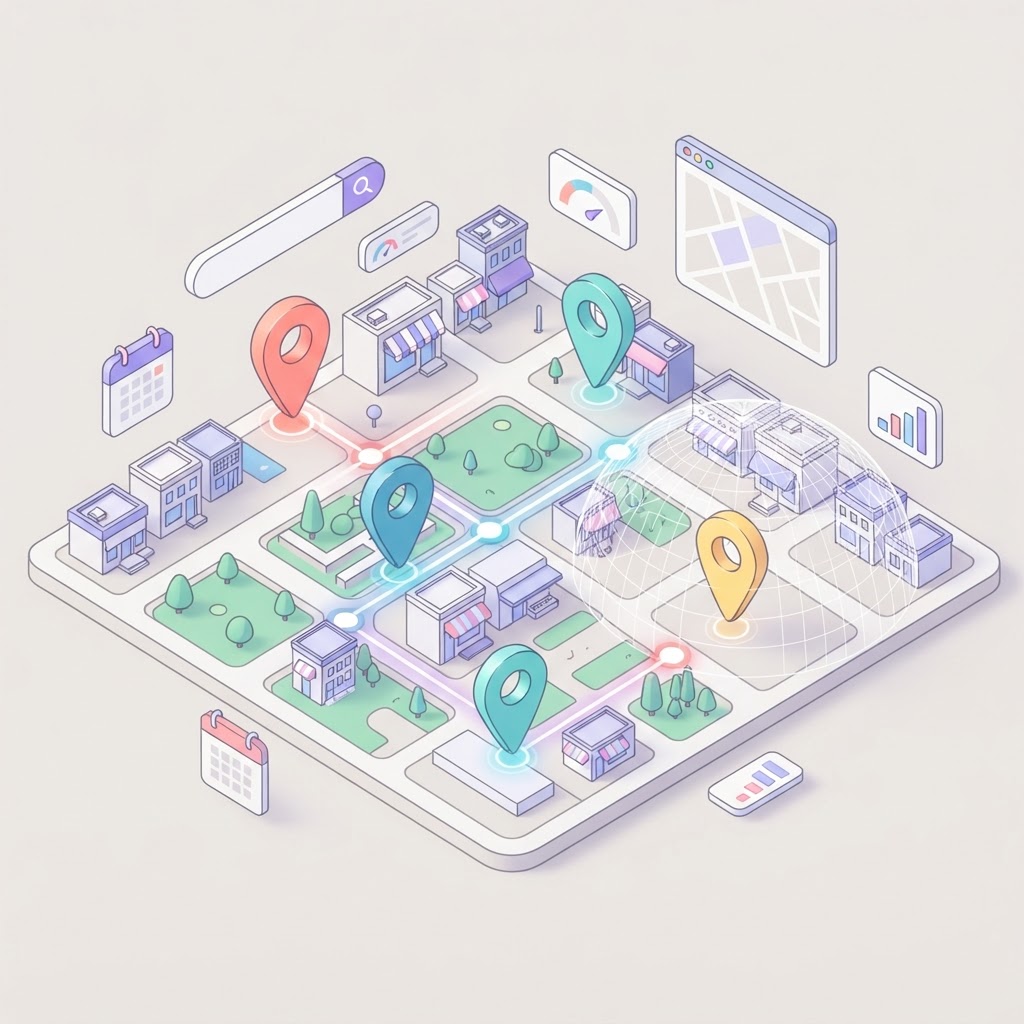
Hyper-local SEO is the practice of optimizing your online presence to rank for highly specific, neighborhood-level search queries. While traditional local SEO focuses on ranking across an entire city (e.g., "plumber in Chicago"), hyper-local SEO targets micro-communities, specific neighborhoods, intersections, and landmarks (e.g., "plumber near Lincoln Park" or "emergency plumber Wrigleyville").
For local service businesses and brick-and-mortar retailers, hyper-local SEO is often the most cost-effective way to capture high-intent customers. People searching at the neighborhood level are usually ready to buy, book, or visit immediately. Furthermore, because these search terms have lower search volume, they are significantly less competitive, allowing small businesses to outrank massive national directories like Yelp or Angi.
See how clearly your website communicates your location and services.
InspectRank reviews your local visibility signals and gives you a clear, prioritized report.
Get My Free ReportWhy City-Wide SEO Is No Longer Enough
Google's local search algorithm is heavily influenced by proximity. If a user searches for a coffee shop, Google will prioritize businesses within a few blocks of the user's physical location, regardless of how well a coffee shop across town has optimized its website.
However, proximity isn't the only factor. Google also looks for relevance and prominence. If your website and Google Business Profile only mention your city, Google may not realize you are the most relevant answer for a searcher in a specific neighborhood on the edge of town. By implementing hyper-local SEO, you feed Google the exact geographic signals it needs to connect you with nearby searchers.
How to Implement a Hyper-Local SEO Strategy
1. Map Your Hyper-Local Entities
Before you can optimize for a neighborhood, you need to know what Google considers important in that area. Open Google Maps and look at the area surrounding your business or target service area. Note the "entities" Google already highlights:
- Neighborhood names and unofficial nicknames: What do locals actually call the area?
- Major intersections and roads: e.g., "businesses off Route 9."
- Landmarks and cultural venues: Parks, stadiums, museums, or historic districts.
- Transit stops: Train stations or major bus hubs.
These entities form the foundation of your hyper-local keyword strategy. You aren't just a "Chicago roofer"; you are a "roofer serving the historic homes near Logan Boulevard."
2. Optimize Your Google Business Profile for Micro-Locations
Your Google Business Profile (GBP) is the engine of your local search visibility. To make it hyper-local:
- Service Areas: If you are a service-area business, do not just list your county. List the specific neighborhoods, suburbs, and zip codes you serve.
- Business Description: Naturally mention your proximity to local landmarks. (e.g., "Located just two blocks south of Centennial Park.")
- GBP Posts: Use Google Business Profile posts to highlight neighborhood-specific projects. If you just finished a landscaping job in a specific subdivision, post a photo and mention the neighborhood name.
3. Build Hyper-Local Service Pages
Do not create dozens of identical pages where you simply swap out the city name (e.g., "Plumber in Neighborhood A," "Plumber in Neighborhood B"). Google considers this doorway content and may penalize your site.
See how clearly your website communicates your location and services.
InspectRank reviews your local visibility signals and gives you a clear, prioritized report.
Get My Free ReportInstead, create unique, high-value location pages that prove you actually work in that specific area. A strong hyper-local service page should include:
- Local case studies: Describe a specific problem you solved in that neighborhood (e.g., "Fixing hard water issues in older Victorian homes in [Neighborhood]").
- Neighborhood-specific regulations: Mention local building codes, HOA rules, or permit requirements you navigate.
- Photos of your team in the area: Show your branded truck parked near a recognizable local landmark.
- Hyper-local schema markup: Use LocalBusiness schema to define your exact service area and coordinates.
4. Leverage Local Community Content
You can build topical authority for a neighborhood by writing about it, even if the topic isn't directly related to your services. This is sometimes called a "local SEO hub" strategy.
For example, a local real estate agent or home inspector could write a guide to "The Best Coffee Shops in [Neighborhood]." While this doesn't directly sell home inspections, it proves to Google that your website is a highly relevant authority on that specific geographic area. When someone later searches for a home inspector in that neighborhood, your site already has established geographic relevance.
5. Earn Hyper-Local Backlinks
A backlink from a massive national website is great, but a backlink from a hyper-local organization is often more effective for local SEO. Look for link-building opportunities within your target neighborhoods:
- Sponsor a neighborhood Little League team.
- Join the hyper-local neighborhood business association (not just the city-wide Chamber of Commerce).
- Partner with a non-competing business down the street for a co-marketing campaign.
- Get featured in a neighborhood newsletter or hyper-local blog.
Common Hyper-Local SEO Mistakes to Avoid
- Keyword Stuffing: Forcing neighborhood names into every sentence makes your content unreadable and can trigger spam filters.
- Ignoring Mobile and Voice Search: Hyper-local searches are frequently performed on mobile devices or via voice assistants (e.g., "Siri, find a hardware store near me"). Ensure your site loads quickly and answers questions conversationally.
- Inconsistent NAP Data: If your Name, Address, and Phone number are inconsistent across local directories, Google will lose trust in your location data.
Measuring Hyper-Local SEO Success
Tracking hyper-local SEO requires looking beyond basic website traffic. Use Google Search Console to monitor impressions and clicks for queries containing your target neighborhood names. Additionally, use UTM parameters on your Google Business Profile link to separate organic website traffic from Google Maps clicks. Finally, track offline conversions—are you actually getting more phone calls and foot traffic from the specific neighborhoods you targeted?
Sources & references
See what InspectRank finds on your website
Get a clear report covering website SEO, technical health, local visibility and AI search readiness.
Get My Free ReportRelated guides
How to Optimize Your Small Business for 'Things to Do' Local Searches
Struggling to rank for 'things to do' in your city? Learn how local entertainment and hospitality businesses can use Barnacle SEO, Google Business Profile optimization, and hyper-local content to capture tourist and local search traffic.

The SEO Impact of Using a Virtual Receptionist or Answering Service
Discover how missed calls damage your local search rankings and why using a virtual receptionist or answering service can protect your Google Business Profile.
How to Optimize Your Small Business for In-Car Navigation Systems
Cars are becoming search engines on wheels. Learn how to optimize your local business for in-car navigation systems like Google built-in, Apple Maps, and TomTom.

The SEO Dangers of Using Stock Photos on Local Service Pages
Do stock photos hurt your local SEO? Learn why generic images destroy customer trust, kill image search traffic, and drag down your Google rankings.

Local SEO for YMYL Businesses: Ranking Medical Spas, Therapists, and Clinics
Ranking a medical spa, therapy practice, or clinic requires navigating Google's strict YMYL guidelines. Learn how to use E-E-A-T, practitioner profiles, and symptom-based SEO to dominate local healthcare search.